
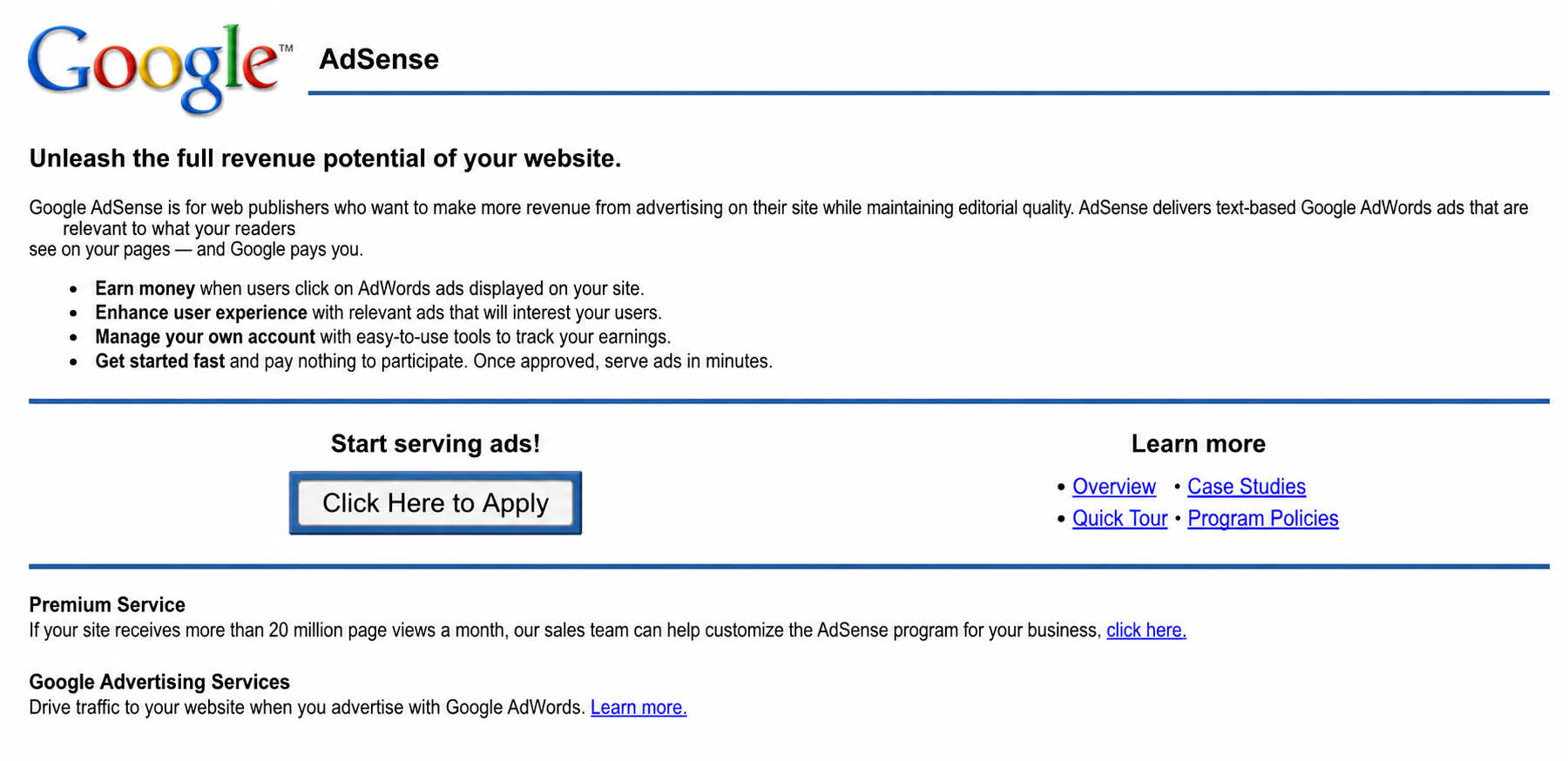
On June 18, 2003, Google launched AdSense — a program that allowed any website owner to display Google's AdWords advertisements on their pages and earn a share of the revenue when visitors clicked. The concept was deceptively simple, but its impact was seismic. AdSense created an entirely new economy of content publishers, niche website builders, and online entrepreneurs who could earn money from their websites without selling anything directly.
How AdSense Worked
The mechanics of AdSense were elegant. A publisher would sign up, get approved, and paste a small snippet of JavaScript code onto their web pages. Google's technology would analyze the content of each page and automatically display relevant advertisements from its AdWords network. When a visitor clicked an ad, the advertiser was charged their bid amount, and Google split the revenue with the publisher — typically keeping 32% and paying the publisher 68% (though exact splits were not publicly disclosed for years).
The contextual matching technology was revolutionary. A page about gardening would show ads for seeds, tools, and fertilizer. A page about mortgage refinancing would show ads from banks and lenders paying $10–$50 per click. Publishers didn't need to negotiate with advertisers, manage billing, or even know who was advertising on their site. Google handled everything.
The Early Days: Extraordinary CPCs
In the early years of AdSense (2003–2006), the cost-per-click rates in certain niches were extraordinary. Financial services keywords like "mesothelioma lawyer," "car insurance," and "mortgage refinance" were generating $20–$80 per click for publishers. A website with a few hundred daily visitors in the right niche could earn thousands of dollars per month from AdSense alone.
This created a gold rush. Entrepreneurs began building "Made for AdSense" (MFA) sites — websites with thin, keyword-stuffed content designed purely to attract AdSense ads and generate clicks. Some MFA site operators were earning six and seven figures annually from networks of hundreds or thousands of sites. The barrier to entry was low: buy a domain, install WordPress, scrape or spin some content, add AdSense code, and start collecting checks.
The MFA Site Economy
At its peak in 2005–2008, the MFA site economy was enormous. Keyword research tools like Overture's Keyword Suggestion Tool (later the Google Keyword Planner) allowed publishers to identify high-CPC keywords and build content around them. Domain registrars reported surges in registrations of keyword-rich domain names. Entire forums and communities (Digital Point, Warrior Forum, Webmaster World) were dedicated to sharing AdSense optimization strategies.
The typical MFA playbook: identify a high-CPC keyword cluster (insurance, legal, financial, medical), register a domain containing those keywords, build 50–200 pages of thin content targeting long-tail variations, drive traffic through search engine optimization or paid traffic arbitrage, and collect AdSense revenue. Some operators ran hundreds of these sites simultaneously.
Click Fraud and Policy Crackdowns
The MFA economy had a dark side: click fraud. Unscrupulous publishers would click their own ads or hire click farms to artificially inflate their earnings. Google estimated that click fraud accounted for 10–15% of all AdSense clicks at the peak of the problem. The company invested heavily in fraud detection and began banning publishers caught in click fraud schemes, often without detailed explanation — a practice that frustrated legitimate publishers who found their accounts suspended.
Google also began cracking down on MFA sites more broadly. In 2007 and 2008, the company updated its AdSense policies to require that sites have "substantial and unique content" and provide "real value" to users. Sites that existed purely to show ads, with no original content, were banned. This policy enforcement, combined with the Google Panda algorithm update in 2011, effectively ended the MFA site era.
AdSense Today
AdSense remains one of the most widely used monetization tools for web publishers, but the economics have changed dramatically. CPCs in most niches are a fraction of what they were in 2005–2008, competition for ad inventory has increased, and Google's policies require genuine, high-quality content. The program now supports display ads, in-feed ads, in-article ads, and matched content recommendations in addition to the original text ads. For legitimate content publishers, AdSense remains a viable revenue stream — but the days of getting rich from thin keyword-stuffed pages are long gone.